MULTIDISCIPLINARY ARTIST
LAST MEALS
Capital Punishment, Redemption & Shared Humanity
Last Meals is a series of oil paintings examining capital punishment through the remains of the final meals requested by people facing execution. The paintings depict neither execution nor portraiture. They show what remains after an ordinary human ritual has been made final by the state: bones, scraps, crumpled napkins, empty containers, and stained trays.
Through these intimate still lifes, the series considers innocence, remorse, redemption, unequal justice, human dignity, and the power of the state. The work does not ask viewers to overlook terrible crimes or the lives damaged by them. It asks whether another death constitutes justice and what is lost when a human life is reduced to a sentence, a case number, or a final menu.
The series has been exhibited across the United States and Canada, including at the Texas State Capitol, with selected paintings published in Wired and international editions of GQ magazine.
“And I say to you, and all those who can listen and will listen, that redemption is tailor-made for the wretched - and that’s what I used to be.” - Stanley “Tookie” Williams
LAST MEAL: RUBEN CANTU

RUBEN MONTOYA CANTU
was 17 at the time of the 1984 San Antonio robbery in which Pedro Gomez was killed and Juan Moreno was seriously wounded. Cantu was convicted of capital murder and executed by Texas on August 24, 1993, at the age of 26.
The case later became the subject of substantial claims that Cantu had been wrongfully executed. Moreno, the prosecution’s central eyewitness, recanted and said that police pressure had influenced his identification. Co-defendant David Garza also stated that Cantu had not participated. The former prosecutor and the jury forewoman subsequently expressed doubts about the conviction.
A 2007 review by the Bexar County District Attorney nevertheless concluded that Cantu was guilty. He was never legally exonerated, and the case remains contested.
Reported final meal:
Barbecue chicken, brown rice, refried beans, and sweet tea. His request for chewing gum was denied.
Last Meal: Ruben Cantu, 2006
Oil on canvas, 16 x 20"
LAST MEAL: CAMERON TODD WILLINGHAM
CAMERON TODD WILLINGHAM
was convicted of setting the 1991 house fire that killed his three young daughters, Amber, Karmon, and Kameron. Texas executed him on February 17, 2004, although he maintained his innocence until his death.
His conviction relied heavily upon interpretations of the fire scene that were later discredited. Before the execution, fire scientist Gerald Hurst reviewed the evidence and concluded that there was no scientific basis for determining that the fire was arson. His report was submitted with Willingham’s clemency petition, but the execution proceeded. Subsequent expert reviews confirmed that central evidence presented at trial was scientifically invalid. His conviction was never overturned.
Willingham’s final meal included three barbecued pork ribs. As I ate them, the number became unbearable: three ribs, three daughters. I could barely choke them down.
Reported final meal:
Three barbecued pork ribs, two orders of onion rings, fried okra, three beef enchiladas with cheese, and two slices of lemon cream pie.

Last Meal: Cameron Todd Willingham, 2007
Oil on canvas, 16 x 20"
LAST MEAL: KARLA FAYE TUCKER

Last Meal: Karla Faye Tucker, 2010
Oil on canvas, 20 x 24"
KARLA FAYE TUCKER
was convicted of the 1983 murders of Jerry Lynn Dean and Deborah Ruth Thornton during a Houston burglary. She was executed by Texas on February 3, 1998, at the age of 38 - the first woman executed by the state since 1863.
Tucker described a life shaped by early drug use and addiction. While incarcerated, she converted to Christianity, expressed remorse, and became widely regarded by supporters as rehabilitated. Her clemency campaign drew international attention and support from religious leaders and public figures.
Members of the victims’ families were divided. Deborah Thornton’s brother, Ronald Carlson, opposed the execution and forgave Tucker, while Thornton’s husband supported it. Her case raises difficult questions about remorse, transformation, forgiveness, and whether earthly redemption can hold meaning within a system committed to execution.
Reported final meal:
A banana, a peach, and a garden salad with ranch dressing.
LAST MEAL: CHARLIE LIVINGSTON
CHARLIE LIVINGSTON
was convicted of the capital murder of Janet Caldwell, a 38-year-old mother of two, during a 1983 robbery outside a Houston grocery store. Livingston was 21 at the time of the crime. Texas executed him on November 21, 1997, at the age of 35.
Unlike the Cantu and Willingham cases, Livingston’s case is not generally presented as a prominent innocence claim. Its inclusion broadens the series beyond wrongful conviction. Opposition to capital punishment need not depend solely upon the possibility of factual innocence; it can also question whether the state should execute at all, including after a grave and proven crime.
Reported final meal: Ribs smothered in onions and gravy, rice with butter, ice water, and Dr Pepper.
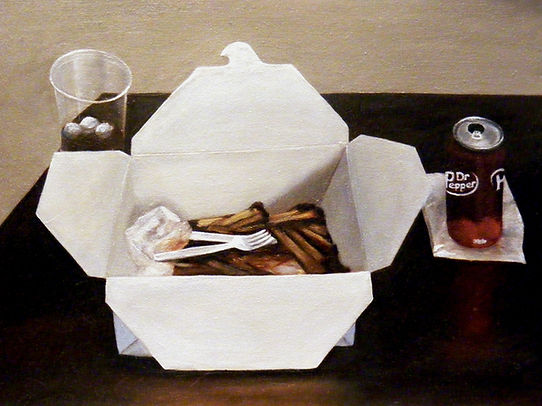
ADDITIONAL LAST MEALS FOLLOW THE BREAK
Last Meal: Charlie Livingston, 2010
Oil on canvas, 16 x 20"
THE PROCESS
Research · Prepare · Eat · Photograph · Paint
Each painting began with research into a specific person and their reported final meal. I prepared and ate the meal, photographed what remained, and then translated the photograph into an oil painting.
The series demanded sustained emotional labor. I spent dozens of hours painting the smallest remnants of each meal while dwelling in the details of a person’s life, case, and final days. The stories remained in my mind long after each painting was complete, and I began needing longer intervals between works.
Years later, the botched execution of John Marion Grant and terrible details surrounding his death compelled me to consider painting again. But amid the racial reckoning of Black Lives Matter, I questioned my place as a white artist: whose stories was I supposed to tell?
Was I preserving a record, or taking possession of stories that were not mine? The answers were complicated, heavy, and mine to navigate alone.
At the time, some states were dismantling their death penalty systems, and I hoped there might eventually be no more final meals to document. Instead, executions have resumed in parts of the United States and continue around the world. The series remains unfinished because the history it records is still being written.


Selected Press
Artists document death row inmates' final taste of life
Wired Magazine, Article, Rachel Zurer, August 2011*
Any Last Requests?
Interview with Russell Bowers, Easter Sunday Special (hour two)
CBC Radio, Interview, April 2011
Last Meals Shine Spotlight on the Death Penalty
Fredericton Gleaner, Article, Tara Chislette, October 4, 2012*
Kate MacDonald Humanizes the Death Penalty
Paintings inspired by last meal requests
The Aquinian, Article, Aly MacIsaac, October 23, 2012
Halálraítéltek utolsó vacsorája – fotó
HVG, Article, September 2011*
Lawmaker Takes Offense to Capitol Art Display
Execution Images Removed by Houston Legislator
American Statesman, Article, W. Gardner Selby, March 13, 2007*
*includes photo publication